
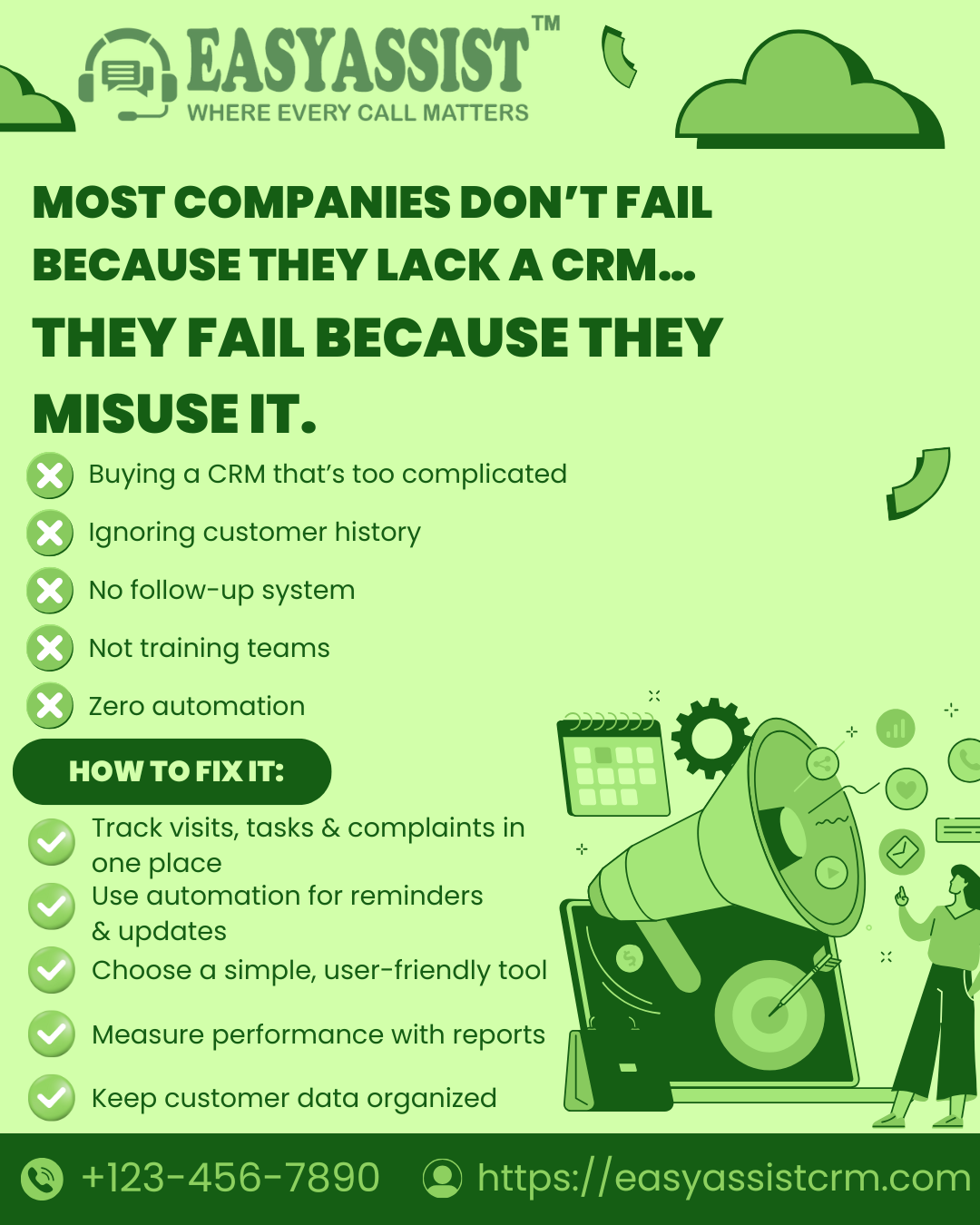
Common CRM Mistakes and How to Avoid Them- Specialization is the Key to Service Center Success
Implementing a CRM system is one of the most critical investments a modern service center, manufacturer, or home appliance company can make. It is your lifeline for after-sales support and the engine for future customer retention. Yet, studies show that a significant percentage of CRM implementations fail or underperform, leaving businesses worse off than before- grappling with low employee adoption, chaotic data, and frustrated customers. The most critical factor driving this failure is often not the software itself- but a foundational mismatch between the tool and the unique complexity of the service industry. A generic CRM designed for B2B sales simply cannot handle the intricacies of Technician Visit Management, spare parts Inventory, and recurring AMC Registration. To ensure your investment succeeds, you must recognize and actively avoid five common CRM mistakes- utilizing a specialized, purpose-built solution to navigate these pitfalls. The Mistake: Believing that any CRM—even one designed primarily for lead generation or sales pipeline tracking—will adequately manage your service operations. This leads to a complex, overly customized system that still lacks core functionality for your specific industry. You end up with a tool that cannot handle the technical flow of a Service Call Registration or track the detailed requirements of a Warranty claim. The Fix: Demand Vertical Focus and Built-in Logic. A specialized, SaaS-based solution for small to medium-sized businesses understands that your business is defined by after-sales support. Look for software that natively includes: Service-Centric Modules: Dedicated Service Call Management and Support Ticket Management that organize and track customer issues for efficient resolution- not just as a footnote in a sales record. Asset Lifecycle Management: Built-in Warranty/AMC Management to register and track contracts, eliminating the need to customize a sales module to handle contractual revenue. Product Ecosystem: Seamless Inventory Management (for stock of products / spare parts) and Product Management to ensure the service side is always aligned with what the customer owns and what parts are needed. The Mistake: Implementing a CRM that serves management but alienates the end-users- the operators logging calls, and especially the technicians in the field. When the software is complex or unresponsive, adoption drops to near zero- leading to data being logged elsewhere, and ultimately, to management being clueless about the Activities of your Technicians/Field Staff. The Fix: Prioritize Ease of Use and Field Mobility. A successful CRM must offer an Effortless & Systematic Interface for All Users and must be Fully Responsive for field access. Technician Visit Management: The system must simplify the field employee's day- allowing for easy assignment and monitoring of tasks given to the employee via the Task Management module. Technicians should be able to log their progress and gather Technician Visit Feedback directly from the site using their mobile device. Training and Adoption: The CRM should be so intuitive that it requires minimal training, providing a "Feel Good Environment" while working- ensuring that the solution integrates into the daily routine- rather than being seen as an extra layer of bureaucracy. The Mistake: Relying on separate systems for voice, chat, and service logging. When customer queries are scattered across phone transcripts, email inboxes, and separate WhatsApp accounts, customer complaints get lost- leading to delayed response times and the most significant cause of customer attrition: repeating their problem. The Fix: Integrate Communication Channels at the Core. The future of CRM acts as a unified communication hub, ensuring Where Every Call Matters. Integrated Call Management: Use the CRM’s Integrated call management system to handle all customer queries efficiently. Omnichannel Support: Implement WhatsApp Management to automate interactions and IVR Management for seamless voice integration, centralizing all communication history against the customer's record. This level of comprehensive service ensures that customers start believing in the brand. The Mistake: Assuming your data is safe just because your CRM is cloud-based (SaaS). For SMEs, data security is paramount. A lack of stringent access control can lead to serious compliance issues and intellectual property risk. The Fix: Demand Enterprise-Grade Security Features. The cost-effective nature of an SME solution should not compromise its security. A secure CRM is Highly Secured by design, often integrating a triple layer of protection: IP Setting: Limiting user access to specific, authorized network locations. Time Bound: Restricting system access to defined working hours. OTP (One-Time Password): Implementing multi-factor authentication for sensitive access. This comprehensive security approach protects your business, your data, and- critically- maintains the customer's trust. The Mistake: Viewing the CRM purchase as a one-time transaction rather than a continuous partnership. Business processes evolve, customer expectations change, and technology advances. A CRM that stagnates will quickly become obsolete. The Fix: Partner with a Developer Committed to Continuous Improvement. The future-proof CRM is backed by a Research & Development unit to keep you updated with new features and technology. This commitment ensures that your software adapts to the market without requiring expensive custom re-engineering. Furthermore, the CRM architecture must be flexible, meaning it must be Easy to integrate with any Module if later required by the client (such as Lead Management, Expense Management, or Quotation Management) without disrupting core operations. This ability to scale incrementally is essential for SME growth. By avoiding these common pitfalls and choosing a specialized CRM that understands the unique pressures of the service industry, you transform your after-sales support from a headache into a proactive Complete Business Management Solution that drives customer loyalty and profitability.Mistake 1: Choosing a Generic Tool Over Specialization
Mistake 2: Ignoring Employee Workflow and Field Staff Needs
Mistake 3: Failing to Centralize All Customer Communications
Mistake 4: Overlooking Critical Data Security
Mistake 5: Treating CRM as a Static Purchase- Not a Partnership